Indication. Chondroplus is indicated for the relief of pain and improvement of joint mobility in patients with mild to moderate osteoarthritis of the knee, ankle and hip. It is administered by a registered medical practitioner as a single intra-articular injection.
Knee pain relief from one injection, for up to a year*
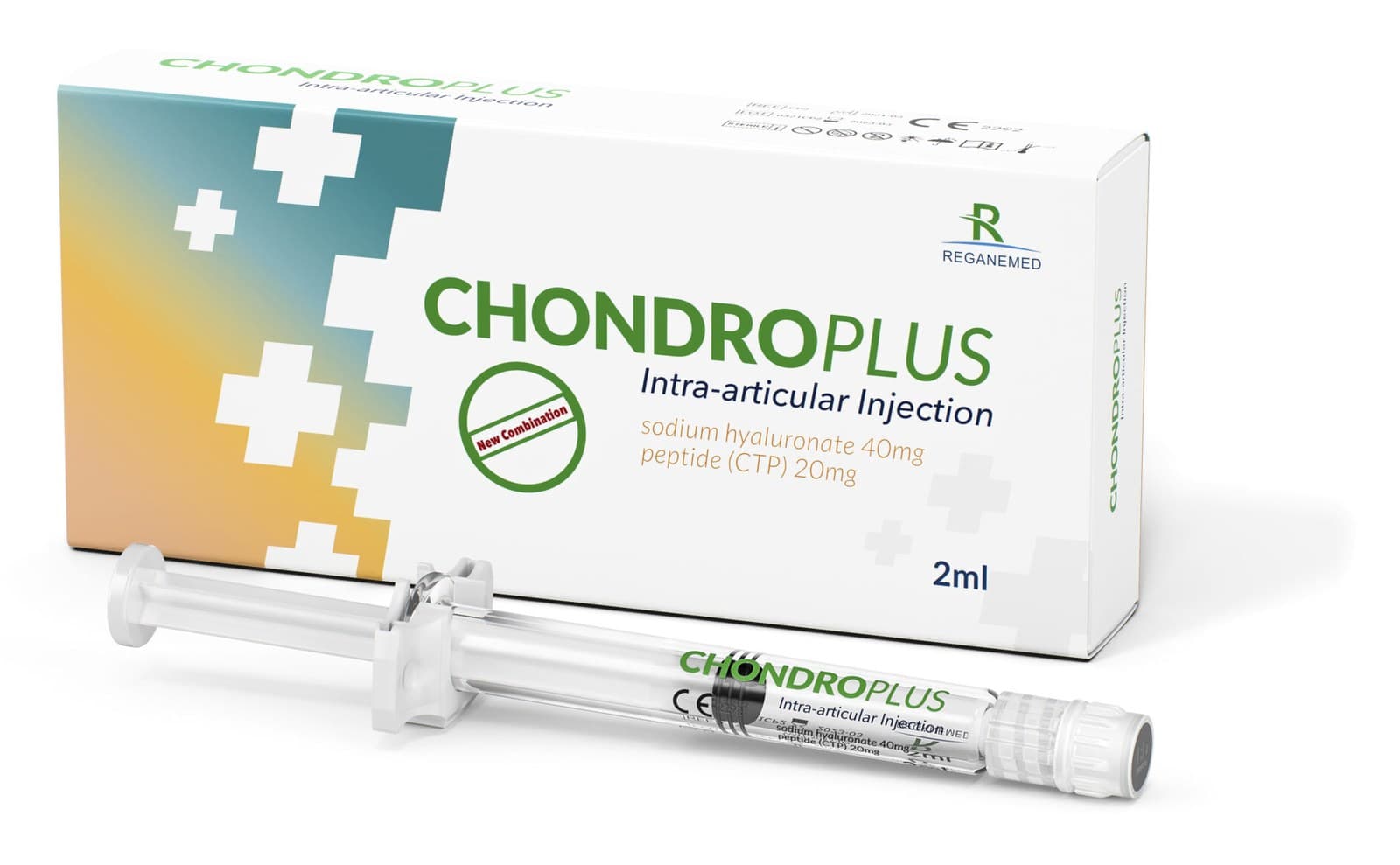
Chondroplus combines two things in a single syringe: hyaluronic acid to restore the cushioning fluid in your knee, and collagen tripeptide to reach the cartilage itself. Your doctor gives it in the clinic, in a few minutes.
Reganemed product information and internal data report 9 months to 1 year from a single injection. The published clinical study followed patients to 6 months. Individual results vary.
Is it right for me?
An injection is not usually the first thing to try. It is for a knee that is still limiting you after the simpler options. Only your doctor can say whether it suits yours, but this is the conversation to have.
Worth asking about if
- You have been told you have osteoarthritis of the knee, ankle or hip
- Pain still limits you despite painkillers, exercise or physiotherapy
- You would rather have one injection than a course of three to five
- A previous hyaluronic acid injection helped but wore off too quickly
- You would prefer a treatment with no animal-derived ingredients
Not suitable, or check first, if
- There is an infection in the joint, or a wound or rash over it
- You have had a reaction to any of its ingredients
- You take blood thinners: tell your doctor before any injection
- You are pregnant or breastfeeding: safety has not been established
- Your knee is hot, swollen and very painful today: that needs assessing first
How it works
Osteoarthritis goes wrong in two places at once: the fluid that cushions the joint, and the cartilage it protects. Most injections only treat the first.
A healthy knee is full of thick, slippery fluid. It cushions every step you take.
- Hyaluronic acid
- Collagen tripeptide
- Chondrocyte, the cell that maintains cartilage
- Enzyme, eating the hyaluronic acid
Thick fluid, smooth surface, working cells
Long chains of hyaluronic acid make the joint fluid thick and slippery, so the cartilage glides and the knee absorbs shock. Inside the cartilage, chondrocytes rebuild the matrix as fast as it wears down.
- In the fluid:
- Long chains, fluid thick and slippery
- In the cartilage:
- Chondrocytes keeping up with the wear
Enzymes cut the chains, and the fluid stops working
In the inflamed joint, enzymes hunt down the hyaluronic acid and chew it into fragments. The chains never get long enough to cushion anything, the fluid turns watery, the cartilage surface erodes, and the chondrocytes fall behind.
- In the fluid:
- Chains eaten faster than they are replaced
- In the cartilage:
- Cells falling behind, surface eroding
Cushioning returns, and then is eaten away again
An injection floods the joint with long chains, so thickness and shock absorption come back and pain falls over two to six weeks. Watch what happens next: the same enzymes are still there, still cutting. Nothing has reached the cartilage cells. Relief fades in three to six months.
- In the fluid:
- New chains in, enzymes still cutting them down
- In the cartilage:
- Cells and surface unchanged
One syringe treats the fluid and the tissue
Cross-linking ties the chains together, so the enzymes bounce off instead of biting through, and the hyaluronic acid stays in the joint far longer. Alongside it, collagen tripeptide is a short enough peptide to diffuse into the cartilage, where it signals chondrocytes to increase matrix synthesis and inhibits degradation.
- In the fluid:
- Cross-linked chains resist the enzymes
- In the cartilage:
- Tripeptide reaches the cells inside
Schematic, not to scale. Neither ingredient regrows cartilage that has already been lost: collagen tripeptide supports the cells that maintain the matrix, which is not the same thing. Duration figures come from Reganemed product information; the published study followed patients to six months.
Nothing in it comes from an animal
Some hyaluronic acid injections are extracted from avian tissue, and their labelling warns anyone allergic to birds, feathers, eggs or poultry. The hyaluronic acid in Chondroplus is produced by bacterial fermentation, and its collagen tripeptide is made synthetically.
That matters for allergy, and for many patients in Malaysia it matters for dietary and religious reasons too. For formal certification status, ask your clinic or us for the current documentation.
- Manufactured by
- Reganemed GmbH, Frankfurt am Main
- Conformity
- CE marked, sterile, single use
- Source
- Bacterial fermentation, non-animal
- Supplied in Malaysia by
- AA Alive Sdn. Bhd. (EVIN)
What to expect
It is usually given by an orthopaedic surgeon, a sports physician or a rheumatologist, in the clinic. The injection itself takes a few minutes.
Before your appointment
Note how long your knee has hurt, what makes it worse, and what you have already tried. The discussion guide below does this for you. Tell the doctor about any blood thinners.
On the day
The doctor examines the knee, often with an X-ray and ultrasound. If the joint is swollen, excess fluid is drained first. The full 2 ml is then injected, ideally under ultrasound guidance so it lands in the joint space.
The first 48 hours
Walk normally, but avoid running, squatting and heavy lifting. Mild aching or warmth for a day or two is common and settles with ice. What is normal and what is not.
The weeks after
It is not a painkiller, so the change builds gradually. Most people notice a difference within two to six weeks.
Making it last
Use the comfortable months to build the thigh muscle that protects the joint. Five exercises that are worth the time.
How long relief lasts
A conventional hyaluronic acid injection is cleared from the joint within months. Cross-linking slows the enzymes that break it down, which is what extends the interval between visits.
How long relief lasts after one injection. Chondroplus is reported to give 9 months to 1 year of relief from a single injection. Conventional hyaluronic acid products are reported to last 3 to 6 months.
The published evidence
A 2024 study in Frontiers in Medicine followed a single ultrasound-guided injection of this combination in 29 patients whose knees typically respond worst: osteoarthritis with coexisting crystal deposits, median grade 3, mean age 70. Each dot below is one patient.
19 of 24
reached a clinically meaningful improvement in pain
79%. Porta et al. 2024, patients assessed at 6 months
20 of 24
reached it on the WOMAC function index
83%. Porta et al. 2024, patients assessed at 6 months
0 of 29
had an injection-related side effect recorded
Porta et al. 2024, all 29 patients injected
Scope of this claim. The 2024 study was retrospective, had no control group, and enrolled 29 patients with 6-month data for 24. It is supportive evidence, not proof of superiority over any other product.
Prepare for your doctor
Appointments are short. Answer these eight questions and you walk in with your history organised, the things your doctor needs to know flagged, and the right questions ready.
1 of 8 answered
My knee: notes for my doctor
- Knee
- Not answered
- How long
- Not answered
- Typical pain
- 5 out of 10
- Worse with
- Not answered
- Morning stiffness
- Not answered
- Already tried
- Not answered
- X-ray
- Not answered
Questions to ask
- Is my pain coming from osteoarthritis, or could it be something else?
- What grade is my knee, and what does that mean for treatment?
- Would an injection help, and which type suits my knee?
- If hyaluronic acid is an option, would a longer-acting one suit me?
- Will the injection be guided by ultrasound?
- What is the total cost, including the consultation?
- Which exercises should I be doing alongside it?
Your own notes, organised for the appointment. Not a diagnosis.
Nothing you enter here is sent to us or stored. It stays in your browser unless you choose to print or share it.
Which knee injection should I have?
It depends on what your knee is doing today. A corticosteroid settles a hot, swollen knee fastest, working in one to three days but lasting only four to twelve weeks. Hyaluronic acid suits a knee that aches on stairs and stiffens after sitting, taking two to six weeks to work and lasting three to six months, or longer if it is cross-linked and combined with collagen tripeptide. PRP suits younger, active patients with early osteoarthritis. No injection regenerates cartilage or cures osteoarthritis.
How it compares with your other options
Four kinds of injection are offered for a worn knee in Malaysia. Prices are typical private clinic ranges in 2026 for one knee, including the fee for the doctor.
| Injection | What it does | Relief lasts | Typical cost | Best suited to |
|---|---|---|---|---|
| Corticosteroid | Switches off inflammation fast | 4 to 12 weeks | RM 120 to RM 400 | A hot, swollen, acutely painful flare |
| Hyaluronic acid | Restores the cushioning of joint fluid | 3 to 6 months | RM 450 to RM 1,500 | Mild to moderate osteoarthritis |
| Platelet-rich plasma | Uses your own platelets to damp inflammation | 6 to 12 months after a course | RM 1,200 to RM 3,500 | Younger, active patients with early wear |
| Hyaluronic acid with collagen tripeptide | Restores the fluid and reaches the cartilage | 9 months to a year | RM 900 to RM 1,800 | People who want one visit rather than a course |
Scope of this claim. Prices quoted for treatments other than Chondroplus are market ranges observed in Malaysian private clinics, not our prices and not an offer. Chondroplus trade pricing is our own first-party price to clinics, excluding tax.
Questions patients ask
Is a knee injection painful?
How long before a knee injection starts working?
How many knee injections can I have?
Will an injection mean I can avoid knee replacement?
Can I drive or work after a knee injection?
Are knee injections covered by insurance in Malaysia?
Which knee injection is the most effective?
Can I have hyaluronic acid and steroid together?
What is the newest knee injection available in Malaysia?
Do knee injections work for bone-on-bone arthritis?
Is a knee injection better than taking painkillers every day?
Should I get an injection in both knees at the same time?
Guides
- Why your knee hurts going down stairs but not upPain on the way down and not on the way up is the most recognisable pattern in knee osteoarthritis. Here is the mechanical reason, and what it tells your doctor.
- Five exercises for knee osteoarthritis that are worth the timeStrengthening the knee is the treatment with the best evidence and the lowest cost. These five movements cover it, with the mistakes that make them useless.
- Why ultrasound guidance matters for a knee injectionInjections placed by feel alone miss the joint space more often than patients realise. What guidance costs, what it changes, and when to insist on it.
- What to expect in the first week after a knee injectionHour by hour and day by day: what is normal after an intra-articular injection, what is not, and when to call the clinic.
Are you a doctor or a clinic?
Trade pricing, stock, delivery across Malaysia and product information for healthcare professionals are on the clinic page.
Go to the page for clinicsMY-CHP-2026-09-001. Date of preparation: September 2026. Intended for healthcare professionals and for patients seeking general information in Malaysia.